
What is Fascia Stretch Therapy™?
It’s not a massage. It’s not a stretching class. And it’s not what you were taught in gym class.
What is Fascia?
Think of a net running through your entire body. It wraps every muscle, threads through every organ, surrounds every nerve and joint and blood vessel. It's one continuous piece, and there's almost nothing in you it doesn't touch.
That's fascia. It's the tissue that holds you together and keeps everything where it belongs.
Here's what most people don't realize: because it's all one piece, fascia doesn't keep problems local. Tight hip flexors can pull on your abdomen. Restriction in the bottom of your foot can show up as a headache. When one area gets stuck, guarded, or scarred over, the tension travels.
Which means treating only the spot that hurts often misses the reason it hurts.
What is Fascia Stretch Therapy™?
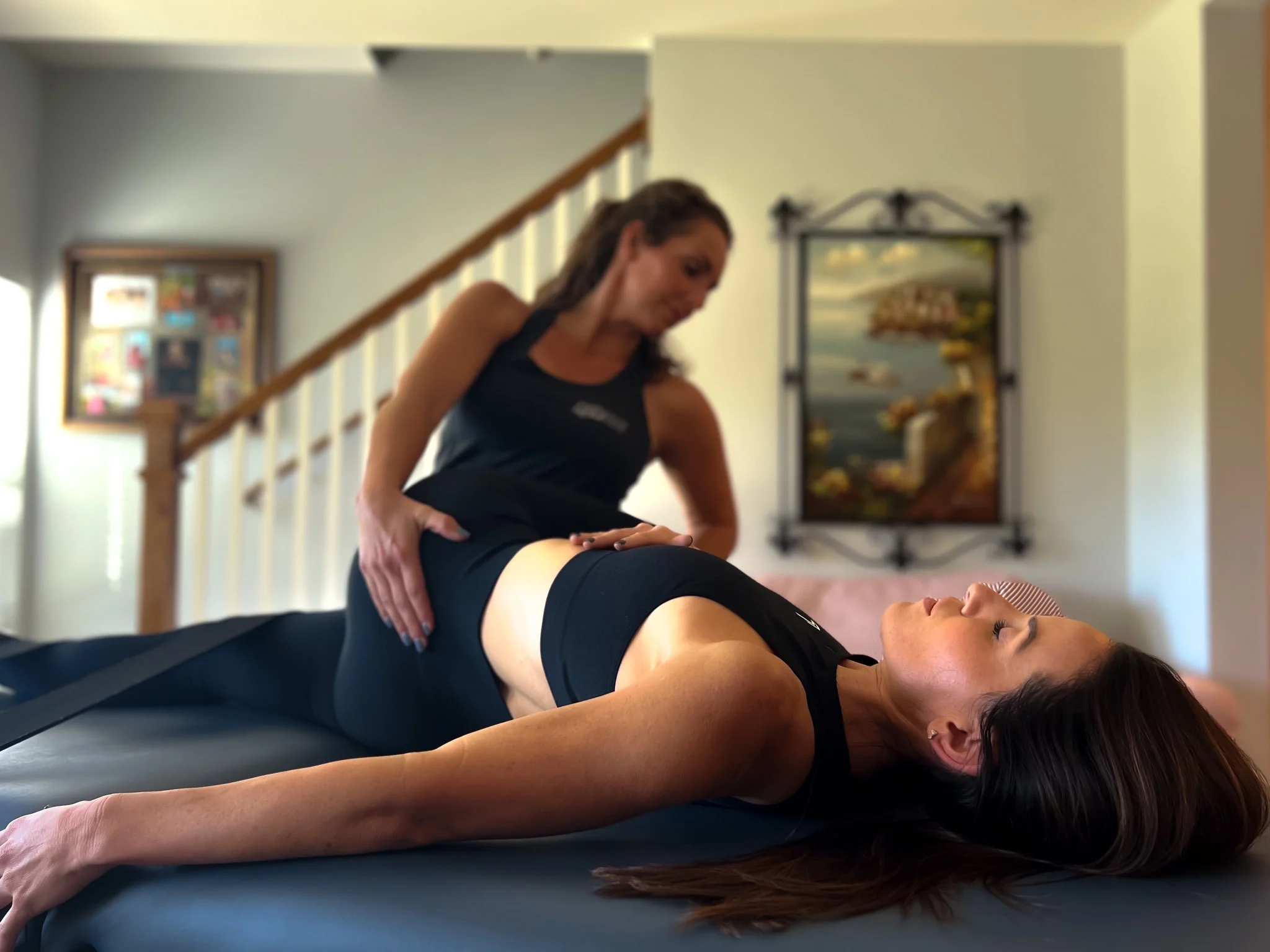
Fascia Stretch Therapy™ is a specialized, table-based technique that works with your fascia and your nervous system together, rather than pushing on muscles one at a time.
You stay fully clothed. You lie on a table with soft straps for stability. And then, instead of you doing the work, Rachel moves your body through slow, rhythmic, circular motions that gradually open up the space in your joints and release tension through entire lines of tissue.
It is not supposed to hurt. That's not a marketing promise, it's how the technique functions. When you feel pain, your nervous system braces. When your nervous system braces, your body holds on tighter. So the whole method is built around staying under that threshold, where your body feels safe enough to actually let go.
Most people describe the feeling afterward as loose, light, and a little bit floaty. Some people can't quite believe how far their body just moved without anyone forcing it.
How is it different from physical and occupational therapy?
This is the question Rachel gets most often, and she's uniquely qualified to answer it. She spent more than twenty years as a physical therapist before retiring her license to focus on this work full time.
Here's the honest comparison.
Physical and occupational therapy are medical services. They usually require a referral or a diagnosis. They're billed through insurance, which means someone other than you and your therapist has a say in how many visits you get and when they end. The goal is typically to restore function after a specific injury or event, and once you hit that goal, you're discharged.
Fascia Stretch Therapy™ is not a medical service, and that's the point. There's no referral required. No insurance company setting a visit limit. No discharge date. You and Rachel decide together what your body needs and how often, based entirely on how you're actually feeling.
There's a difference in approach, too. PT and OT tend to focus on the region that's affected: the knee, the shoulder, the specific movement you can't do yet. FST works the whole system, because the whole system is connected. You may come in for your hip and leave noticing your neck feels different.
And here's what Rachel wants you to know: this is not a replacement for physical therapy. If you need PT, you need PT, and she'll tell you so and point you toward someone good. She's not interested in being the only tool in your toolbox. She's interested in being the right one, at the right time.
How it’s different from massage and stretch franchises.
It isn't massage. Massage works into muscle tissue with pressure. Valuable, but different. FST moves your joints and lengthens fascial lines through motion. You keep your clothes on and you're an active participant in the session, not a passive one.
It isn't myofascial release, either. That technique works by pressing deeply into restricted tissue until it releases, and it can be intense. Great work in the right hands for the right problem. It's simply a different approach than this one.
And it isn't what you'll find at a stretch franchise. Those sessions tend to follow the same script for every person who walks through the door. FST has hundreds of possible stretches, and the ones you get are chosen for your body, on that day, based on an actual assessment. Nothing about it is templated because we move the body further into a more usable range of motion as it opens up.
What Fascia Stretch Therapy™ can do for you.
If you're in pain or recovering, FST can help you move with less guarding and more confidence, especially when you've already tried other things that didn't fully work.
If you're an athlete, more usable range of motion means more power, faster recovery between efforts, and a body that can absorb stress instead of tearing under it.
If you're investing in feeling good long term, regular sessions help you stay ahead of the stiffness, tension, and slow loss of mobility that most people just accept as part of getting older.
And across all three, people consistently report better sleep, lower stress, and a nervous system that finally stops running in overdrive.
FST pairs well with the rest of your care.
Fascia Stretch Therapy™ isn't meant to replace your chiropractor, your massage therapist, your acupuncturist, or your doctor. It works alongside them.
When your fascia is balanced, chiropractic adjustments tend to hold longer. When your tissue isn't fighting back, other bodywork goes deeper with less effort. Rachel refers out regularly and works in coordination with other practitioners across Middle Tennessee. Your care is a team, and she's glad to be one part of it.
Who’s Doing The Work With You
Rachel Cain is a retired physical therapist and a Level 4 Certified Fascia Stretch Specialist, trained through the Stretch to Win Institute in Phoenix, Arizona. Level 4 is the highest certification the Institute offers, and only a few hundred practitioners in the country hold it.
She also holds a LifeStretch instructor certification, which means she can teach you what to do between sessions, not just work with you you during them.
That's the part she cares about most: not just helping you feel better on the table, but helping you understand your own body well enough to take care of it yourself.
Not in Tennessee? Find a FST provider in your area.
Fascia Stretch Therapists are all over the country, and the Stretch to Win Institute is the only certification for FST that you should trust.
Click HERE to search the directory for a practitioner near you.